Inside the Central Bank of Libya — the numbers behind the budget surplus and the $5 billion foreign-currency gap
Official data show Libya used more than $5 billion in foreign currency beyond what it received in oil revenues and royalties during the first eight months of 2026. A source inside the Central Bank says the pressures run deeper than the published figures suggest, pointing to favouritism, weak oversight and retaliation against staff who insist on professional independence within the institution charged with protecting the dinar.


The Central Bank of Libya's August 2026 statement presents two apparently conflicting pictures of the state's finances. In dinar terms, public revenue exceeded recorded expenditure by more than LYD30 billion. In foreign-currency terms, however, the CBL received US$15.190 billion in oil revenues and royalties while total foreign-currency use reached US$20.175 billion. The difference was US$4.985 billion in only eight months. The bank said part of that gap was covered by returns on its investments. [1]
The same report shows why letters of credit sit at the centre of Libya's monetary debate. Commercial banks used US$17.397 billion in foreign currency between January and August. Of that amount, US$9.008 billion went through letters of credit, equivalent to 51.8 per cent of commercial-bank foreign-currency use. Personal foreign-exchange transactions accounted for US$5.913 billion and other transfers for US$2.437 billion. [1]
These official numbers form the verifiable core of this inquiry. I am a former CBL employee and remain in professional contact with people who work inside the institution. That background helps me understand its structure and practices, but it does not independently prove any allegation. This article also draws on disclosures from a confidential source with direct knowledge of CBL operations. The source's identity is withheld because the allegations concern current employment, internal decision-making and possible retaliation. Several personnel and governance claims could not be independently corroborated through public records. They are therefore presented as allegations, not established findings, and should be put to the CBL, the National Commercial Bank and Governor Naji Issa before publication.
What the official numbers show
The dinar's apparent budget surplus and the foreign-exchange shortfall measure different things. The first compares revenue and expenditure recorded in Libyan dinars. The second compares hard-currency inflows with hard-currency use. Converting oil revenue into dinars at the official exchange rate can produce a fiscal surplus on paper even while the banking system consumes dollars faster than current oil receipts replace them.
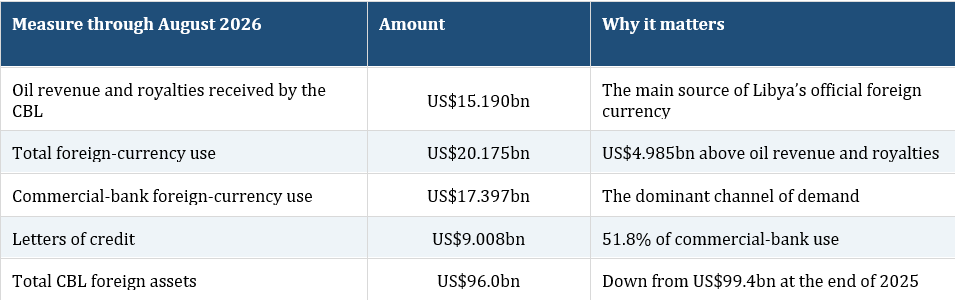
That distinction matters because Libya cannot create dollars in the way it can create dinar liquidity. A persistent foreign-exchange shortfall must be financed from investment income, other external receipts, asset sales or reserves. It can also be reduced by restraining demand. The August report shows that the CBL's total foreign assets fell from US$99.4 billion at the end of 2025 to US$96.0 billion at the end of August 2026, a decline of US$3.4 billion. [1] The published total does not reveal how much is immediately liquid, unrestricted and available for intervention.
The insider disputes the size of the gap
The insider argues that the effective foreign-currency deficit is closer to US$12 billion than the reported US$4.985 billion. No document reviewed for this article independently establishes that figure, and the two numbers may use different definitions. The CBL's published gap compares oil revenues and royalties received during the period with total recorded foreign-currency use. An internal liquidity estimate might also include commitments not yet settled, restricted assets, delayed transfers, liabilities or a narrower definition of deployable reserves.
The US$12 billion claim should therefore not be presented as a corrected official number without the underlying schedule. It is nevertheless testable. The CBL could disclose a reconciliation showing gross foreign assets, liquid and unrestricted reserves, committed but undisbursed foreign currency, short-term external obligations, investment income and the timing basis used in the August statement. Without that bridge, the public cannot determine whether the disagreement reflects misconduct, a legitimate accounting difference or a mixture of both.
The source further alleged that employees who insist on reporting unfavourable figures risk dismissal, reassignment to less influential departments, exclusion from paid committees and loss of access to foreign training. This allegation could not be independently verified. If accurate, it would raise a serious problem: a central bank cannot manage exchange-rate risk when its internal incentives reward agreeable numbers rather than accurate ones.
Why letters of credit create exceptional rents
A letter of credit is meant to facilitate legitimate imports. A commercial bank evaluates an importer's application and documents, and the CBL provides foreign-currency coverage after review. The economic rationale is straightforward. Libya earns dollars largely from oil, imports much of what it consumes and needs an orderly banking channel through which businesses can pay foreign suppliers. Official-rate financing should lower import costs and restrain inflation.
The same system creates an extraordinary rent when access is selective and the parallel exchange rate is far above the official rate. On 16 September, the dollar reportedly reached LYD9.50 in the parallel market while the official rate was approximately LYD6.36. [2] The implied parallel-market premium was about 49.4 per cent. An importer able to obtain US$1 million at the official rate would pay roughly LYD6.36 million. The market value of the same dollars at LYD9.50 would be LYD9.50 million, creating a gross price differential of about LYD3.14 million before costs and risks.
That does not make every LC improper. Most imports are necessary, and legitimate businesses require predictable access to foreign currency. But a large and persistent premium changes incentives. It encourages applicants to overstate quantities or prices, substitute cheaper goods for the products approved, divert goods after entry, or use fictitious trade documents to gain access to dollars. My earlier research describes this mechanism as a link between official allocation, rent-seeking and the parallel market rather than a simple failure to select the correct exchange rate.
The historical warning signs
The vulnerability is documented. A 2021 Global Witness investigation reported that nearly US$2.5 billion in Libyan LCs were issued during only 13 weeks between April and July 2020. It found that approved credits for meat exceeded the entire annual value of meat exports to Libya in each of 2016, 2017 and 2018. It also described a US$110 million credit intended for power generators that was reportedly redirected to an unrelated company before payments were halted over suspected corruption. [3] The CBL disputed the report and described it as containing inaccuracies. [4]
Those cases do not prove current wrongdoing, and they do not establish that the present governor participated in any improper transaction. They show why the LC system requires disclosure that permits external verification. Customs records, shipping data, supplier identities, beneficial ownership, historical unit prices and physical inspection should correspond with each other. A banking file can appear complete while the underlying trade is economically implausible.
Questions about supervision and committee appointments
Naji Issa became governor in September 2024 after serving as director of the CBL's Department of Banking and Currency Supervision. [5] The insider says Issa had also participated in the committee structure associated with letters of credit before his appointment as governor. That history does not establish corruption. It does create a legitimate accountability question: how did the department identify, escalate and resolve suspicious LC activity during the period in which Issa held supervisory responsibility?
The insider alleges that problems inside Banking Supervision persist and have become more serious. According to the source, the department is especially sought after because of its influence over high-value banking decisions and access to committees. The source also claims that since Issa took office, committee assignments have repeatedly gone to a limited group of employees regarded as personally or politically favoured. No committee rosters, appointment decisions or payment records were available to verify that allegation. Publication should seek those records and compare appointments before and after September 2024.
The CBL has emphasised that commercial banks, rather than the central bank itself, grant LCs according to their credit and documentary standards, while the CBL's role is to provide coverage after review. [6] That division of responsibility should not end the inquiry. It makes the chain of accountability more important. Investigators need to know what commercial banks approved, what the CBL reviewed, which warning indicators were triggered, who authorised coverage and whether related companies were treated as a single economic group.
The cost of marginalising expertise
Several of the insider's most consequential allegations concern personnel rather than individual transactions. The source claims that experienced managers have been removed or reassigned when they lacked political protection, resisted pressure to produce preferred figures or failed to demonstrate sufficient personal loyalty to senior leadership. These are serious claims that require employment orders, organisational charts and testimony from additional sources.
One example concerns the Research and Statistics Department, which is responsible for collecting, tabulating and disseminating the data used by policymakers, banks, researchers and the public. The insider says the department currently lacks a permanent manager after its previous head was brought into the governor's office as a senior adviser. The source also described an appointment in administrative affairs involving a person whose academic specialisation was hotel management. The issue is not that every administrative post requires an economics degree. The relevant questions are whether the appointment followed transparent criteria and whether the appointee had experience appropriate to the authority of the position.
The insider also described the cases of 11 former CBL employees who had been sent abroad to complete graduate studies, mainly doctorates, in the United States, the United Kingdom, Türkiye and other countries. According to the source, the employees exceeded the period originally approved for their studies, later sought reinstatement and obtained a court decision in their favour, but the CBL's legal department succeeded in reversing that outcome and their dismissals became final. The source contrasted their exclusion with a subsequent CBL recruitment announcement and alleged that some new hires were selected through connections to the governor. These assertions require the scholarship decisions, leave rules, court judgments, final dismissal orders and recruitment records before any conclusion can be drawn.
The National Commercial Bank connection
The insider raised a separate concern involving the National Commercial Bank, a major Libyan commercial bank subject to CBL regulation and supervision. The source claims that the CBL is investigating extensive corruption and financial irregularities at NCB. The source further alleges that before becoming governor, Issa served successively as a member, deputy chairman and chairman of NCB's board. Publicly accessible records reviewed for this draft did not confirm the full sequence of positions or the reported investigation.
The connection deserves examination but should not be framed as proof of culpability. If the investigation exists, its mandate and period of review are crucial. Did any alleged misconduct occur while Issa held a board position? Did he participate in decisions now under examination? Has he recused himself from oversight? What did internal and external auditors report? The answers could establish responsible prior governance, reveal institutional weaknesses or dispel an allegation that currently rests on one source.
Transparency has become part of the dispute
The insider argues that the present administration has reduced transparency around LC beneficiaries and the goods financed. The public record requires a more qualified conclusion. The CBL published detailed LC notices during 2025, including company and transaction information, and its August 2026 statement said it was issuing a special annex showing commercial-bank foreign-currency use by commodity, company, country and port of entry. [1][7]
The question is therefore not simply whether the CBL publishes anything. It is whether disclosure is complete, timely, searchable and sufficient to identify related parties and verify that goods arrived at reasonable prices. A long list can create the appearance of transparency while concealing concentration across companies controlled by the same beneficial owners. The CBL should publish machine-readable data, unique company identifiers, beneficial ownership, approving bank, value, commodity classification, supplier country, port of entry and the status of customs verification.
High oil prices and a weakening dinar
The dinar's continued deterioration is especially difficult to explain politically because oil prices have remained unusually high since the Iran war began in late February 2026. Brent traded above US$100 in July and reached roughly US$109 in mid-September. [8] Libya's oil-dependent economy would normally be expected to benefit from such a price environment. Yet the parallel-market dollar reached LYD9.50 while the official rate remained near LYD6.36.
High prices alone do not guarantee currency appreciation. Export volumes, payment timing, production costs, off-budget transactions, public spending and foreign-currency demand all matter. The August statement provides the clearest immediate explanation: even during an oil-price windfall, foreign-currency use exceeded current oil revenues and royalties by almost US$5 billion. If that pattern persists while oil remains expensive, a return of Brent toward US$60 would expose the dinar to considerably greater pressure unless spending and allocation practices change.
From currency losses to salary protests
Central-bank governance reaches households through prices and purchasing power. A public employee can receive the same number of dinars each month while becoming poorer in real terms when the currency weakens and import prices rise. This is one reason the exchange rate cannot be separated from the recent expansion of salary protests in western Libya. Teachers, healthcare workers, retirees and oil-facility guards were among the groups reported to be protesting or striking in September 2026. [9][10]
Salary increases may provide temporary relief, but across-the-board increases financed without corresponding revenue or productivity can add dinar liquidity and intensify demand for dollars. That can weaken the currency further and erode the value of the raise. The underlying issue is therefore larger than the nominal wage. It is whether Libya's institutions can protect the real purchasing power of salaries by managing public spending and foreign currency credibly.
A cyberattack and an unexplained resignation
The internal allegations arrive after two events that have already raised public questions about the institution. On 9 June, the CBL announced that some systems and technical services had been affected by a cyber incident and said it had isolated suspected systems and activated continuity plans. [11] Later that month, the bank acknowledged that a sample of purported data had appeared on the dark web. The incident does not prove financial misconduct, but it tests controls at an institution holding sensitive financial, commercial and personal information.
On 9 August, Issa submitted requests to be relieved of his duties and declined to state his reasons because of their sensitivity. The House of Representatives' Planning, Finance and General Budget Committee and figures in the High Council of State rejected the resignation and urged him to continue. [12][13] The resignation letter did not connect the decision to the allegations described in this article. Its unexplained language nevertheless intensified speculation at a time of mounting pressure on the dinar.
Life inside the institution
The insider described morale inside the CBL as deeply depressed. The source said experienced employees have left for other institutions and that remaining staff may continue primarily because their families depend on their salaries. This account is subjective and needs corroboration through interviews with current and former employees. It is relevant because central banks depend on institutional memory and technical independence. Losing experienced economists, supervisors, statisticians, auditors and technology specialists weakens the capacity to detect precisely the risks the public expects the bank to control.
Questions that require answers
- How does the CBL reconcile the reported US$4.985 billion foreign-exchange gap with the insider's US$12 billion estimate, and what definitions does each figure use?
- How much of the reported US$96 billion in foreign assets is liquid, unrestricted and immediately available, and how much is committed or otherwise unavailable?
- Which committees have governed LC review, foreign-currency coverage and related oversight since September 2024, who served on them and what compensation did members receive?
- What controls identify related companies, over-invoicing, unusual unit prices, fictitious suppliers, diverted goods and repeated use of the same beneficial owners?
- Has the CBL investigated the National Commercial Bank, and what were Naji Issa's exact positions and dates of service on its board?
- Is the Research and Statistics Department led by a permanent director, and have any employees been reassigned or disciplined after disputing data requested by senior management?
- What happened in the cases of the 11 scholarship employees, and how did their qualifications compare with subsequent recruits?
- Why did Issa seek to leave office in August, and what were the sensitive reasons he declined to disclose?
- What information was compromised in the June cyberattack, and what independent security review has been completed?
- Will the CBL publish LC data in a machine-readable form that identifies beneficial ownership and allows transactions to be matched with customs and shipping records?
The institutional test
The disclosures presented here do not by themselves establish that Governor Issa or other named officials committed corruption. They establish a set of specific, answerable questions about foreign-currency accounting, LC oversight, personnel decisions, bank supervision and transparency. The official data already show a system under pressure. Libya used almost US$5 billion more foreign currency than it received in oil revenues and royalties during the first eight months of a year marked by exceptionally high oil prices. More than half of commercial-bank foreign-currency use went through letters of credit.
The CBL cannot restore confidence by publishing totals alone. It must allow the public to understand who receives access to official-rate dollars, how applications are assessed, whether goods enter Libya at plausible prices, how related companies are identified, and how much of the country's foreign wealth is truly available. It must also show that employees responsible for producing data and supervising banks can report unwelcome findings without professional punishment.
Libya's currency crisis is ultimately a governance crisis expressed through the exchange rate. When access to dollars determines private fortunes while a falling dinar erodes ordinary salaries, central-bank transparency becomes a question of distributional justice. If the insider's allegations are false, detailed disclosure can refute them. If any are accurate, the cost of silence will be paid not only in reserves or accounting balances, but in the purchasing power of every Libyan household.
Featured
All reports